




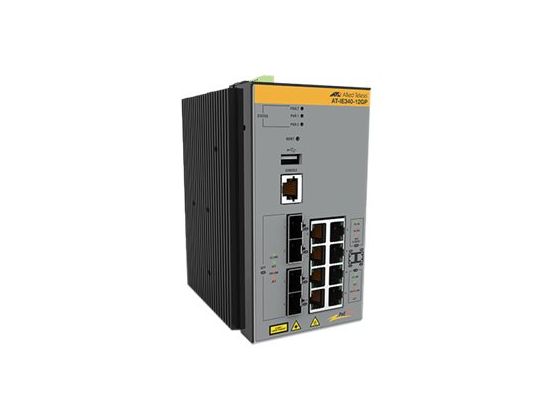
Allied Telesis IE340 is a high-performing and feature-rich choice for the networks. The IE340 is ideal for Industrial Ethernet applications, being fully qualified for manufacturing, automation, process control, railway transportation, roadway transportation and smart cities. With a fanless design and a wide operating temperature range, the IE340 tolerates the harsh and demanding environments found in industrial and outdoor deployments.
- Securing the network edge
- Gigabit and fast Ethernet
- Configurable PoE power budget and dynamic power allocation
- Quality of service (QoS)
- Dynamic Host Configuration Protocol (DHCP) snooping
- Power over Ethernet plus (PoE+)
- Alarm input / output
Securing the network edge
Ensuring data protection means controlling network access. Protocols such as IEEE 802.1X port-based authentication guarantee that only known users are connected to the network. Unknown users who physically connect can be segregated into a pre-determined part of the network. This offers guests Internet access, while ensuring the integrity of private data.
Gigabit and fast Ethernet
The IE340 SFP ports support both Gigabit and fast Ethernet small form-factor pluggables (SFPs). This makes the IE340 ideal for environments where Gigabit fiber switches will be phased in over time, and allows for connectivity to the legacy 100FX hardware until it is upgraded to Gigabit Ethernet. Support for both speeds of SFP allows organizations to stay within budget as they migrate to faster technologies.
Configurable PoE power budget and dynamic power allocation
On PoE-sourcing IE340, the overall power budget can be configured to establish a close relationship between the power sourcing feature and the real capabilities of the external power supply unit (PSU). PoE power is allocated dynamically, based on the current usage of each powered device.
Quality of service (QoS)
Comprehensive low-latency wire-speed QoS provides flow-based traffic management with full classification, prioritization, traffic shaping and min / max bandwidth profiles. Enjoy boosted network performance and guaranteed delivery of business-critical Ethernet services and applications. Time-critical services like voice and video applications take precedence over non-essential services like file downloads, maintaining responsiveness of Enterprise applications.
Dynamic Host Configuration Protocol (DHCP) snooping
DHCP servers allocate IP addresses to clients, and the switch keeps a record of addresses issued on each port. IP source guard checks against this DHCP snooping database to ensure only clients with specific IP can access the network.
Power over Ethernet plus (PoE+)
With PoE, a separate power connection to media endpoints such as IP phones and wireless access points is not necessary. PoE+ reduces costs and provides even greater flexibility, providing the capability to connect devices requiring more power such as pan, tilt and zoom security cameras.
Alarm input / output
Alarm input and alarm output are useful for security integration solutions. These respond to events instantly and automatically on a pre-defined event scheme, and send an alert message to the monitoring control center. The 2-pin terminal blocks may be connected to sensors and actuator relays. Alarm input receives signals from external devices like motion sensors and magnets that will trigger subsequent actions if something changes. Alarm output controls external devices upon an event, for example sirens, strobes and PTZ cameras.