Carbon Reduction Plan 2026
Stone Technologies Limited trading as Converge Technology Solutions is committed to achieving Net Zero emissions by 2045.
Download PDF
Commitment to achieving Net Zero
Converge is committed to achieving Net Zero emissions Scope 1 and Scope 2 Net Zero by 2030 and All Scopes by 2045.
Baseline Emissions Footprint
Baseline emissions are a record of the greenhouse gases that have been produced in the past and were produced prior to the introduction of any strategies to reduce emissions. Baseline emissions are the reference point against which emissions reduction can be measured.
Baseline Year: 2019 (*Scope 3 baseline 2023)
Additional Details relating to the Baseline Emissions calculations.
Baseline calculations are based on those emissions over which Converge has direct control with Scope 3 emissions initially limited to those produced from the company’s grey fleet.
Baseline Year Emissions: Jan-Dec 2019
EMISSIONS |
TOTAL (tCO2e) |
|---|---|
| Scope 1 | 552.4 tCO2e |
| Scope 2 | 182.7 tCO2e |
| Scope 3 (Included Sources) | 13.8 tCO2e* |
| Total Emissions | 748.9 tCO2e |
Current Emissions Reporting: Jan-Dec 2025
EMISSIONS |
TOTAL (tCO2e) |
|---|---|
| Scope 1 | 458.9 tCO2e |
| Scope 2 | 0 tCO2e |
| Scope 3 (Included Sources) | 213,878 tCO2e |
| Total Emissions | 214,337 tCO2e |
| Carbon Offset Purchase | 50 tCO2e |
Emissions Reduction Targets
In 2023 we embarked on assessing our complete Scope 3 carbon footprint. This analysis covers emissions from our direct operations and within the value chain. This year we have been able to identify trends and analysis in Scope 3.
This transparency of the full carbon impact demonstrates our steps towards our goal of achieving net-zero emissions, emphasising the critical need to escalate your efforts in minimising your carbon footprint in the forthcoming years. Furthermore, there's a significant opportunity to enhance the precision of your carbon footprint estimations through improvements in data quality. More accurate and refined data has led to more reliable calculations, enabling more targeted and focused carbon reduction actions within Scope 3.
A key challenge in managing the reduction in net emissions is accommodating the additional impact of underlying growth in business activities. The Streamlined Energy & Carbon Reporting (SECR) disclosure included in the company’s annual accounts reports an intensity measure, stated in tonnes of CO2 per £1m of revenue, to better reflect the extent to which the business has managed these divergent challenges.
With full visibility of our carbon impact across scopes 1 and 2 we can clearly have a benchmark, Emissions/Turnover has decreased from 4.25 per £1m to 2.99 per £1m. We have identified that 99% of our carbon impact is within Scope 3.
However, we must not lose sight of the pathway target which requires reductions in absolute amounts of emissions. We continue to reduce our Scope 1 and 2 emissions by rationalising our vehicle fleet and embracing renewable energy now with solar panels installed. We have also transitioned during 2025 to 50% biogas for heating which will make a positive impact on Scope 1 in 2026 figures. Scope 3 has increased but this is largely due to increase in the investment section as we have come a real living wage employer and putting more monies into the pension and the investment choices of the employees and the pension provider.
As an award-winning Circular Economy IT Solution provider we are helping to combat climate change and are avoidable Zero to Landfill accredited.
In order to continue our progress in achieving Net Zero, we have adopted the following carbon reduction targets.
We project that carbon emissions can be halved to 97,005 tCO2e by 2035.
Our carbon reduction targets are:
- 25% by 2030 – 100% Scope 1 and Scope 2
- 75% by 2040
- 100% Net Zero by 2045
Progress against these targets can be seen in the graph below:
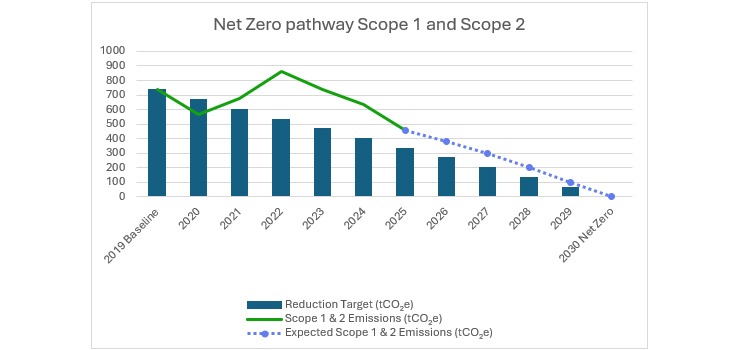
As our base year for Scope 3 started in 2023 we can demonstrate our proposed carbon emissions reduction.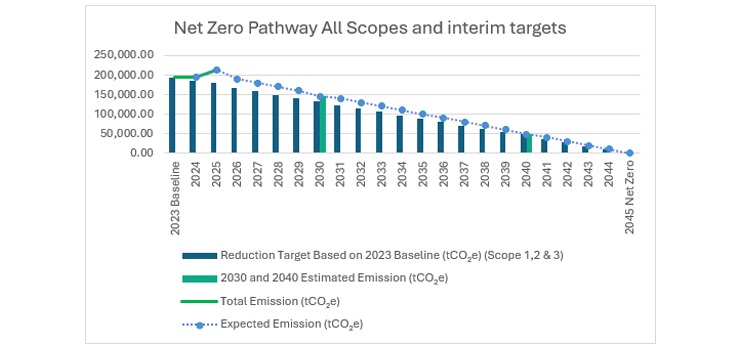
Carbon Reduction Projects
Completed Carbon Reduction Initiatives
The following environmental management measures and projects have been completed or implemented since the 2019 baseline and the measures will be in effect when performing the contract:
Environmental performance:
- Improvements to our packaging materials
- Converge used new andinnovative packaging techniques and materials for its own brand products to remove all unnecessary single use plastic packaging.
- Encouraged palletised deliveries to reduce amount of protection packaging for items.
- Adopted unbleached packaging boxes and reinforced paper tape.
- Adopted paper based protective packaging product that is both 100% recycled and 100% recyclable.
- Implemented a new packaging system utilising carboard inserts to reduce the usage of bubble wrap.
- Waste segregation for food waste recycling companies (for means like turning it into fuel through anaerobic digestion)
- Zero Avoidable Waste to Landfill Accreditation
- 100% renewable electricity at Stafford and installation of Solar Panels and 100% renewable in Bathgate
- Introduction of Biogas now 50% of heating at Stafford
Carbon Offset
In 2025 we have purchased 50 tCO2e Carbon Credits to support the refurbishment in social housing. Supporting families to make homes warmer and more economically and delivering social value across England.
As identified in previous years the commercial fleet is a major contributing factor to our carbon emissions and we are working closely with providers to address this.
Products
Our Sustainability team works with our in-house R&D facility and component suppliers to calculate an estimated whole-life product carbon cost per unit. This includes costs from:
- The manufacture of components and sub-assemblies
- Final unit assembly in our configuration facility
- Logistics
- Servicing
- Energy required to run the device throughout its service life.
- Investment in data to enable customers to receive E Invoices providing the carbon measurement including Scope 2 and Scope 3 of device purchases.
The largest single contributor to the carbon cost per unit we can influence are those relating to the logistics involved in sourcing and supplying the product. We are working with our extended supply chain to reduce the whole-life product carbon cost per unit and welcome the opportunity to discuss potential savings with our customers.
Product whole-life carbon cost reduction strategies
- Fuel efficiency and reduction of CO2 per £1m turnover:
- Targeting further annual reduction by using electric vehicles.
- Target of a 10%/£1M reduction in fuel usage and carbon emissions related to business travel, both for pre-sales/sales activities, and for our warranty services divisions, over the next 3 years.
- Supply chain: Converge has set its supply chain component partners a target of 20% carbon cost reduction in the manufacture and nested supplier supply chain logistics footprint over the next 5 years.
- Implementation of new industry technologies for power consumption reduction as soon as they become available, to reduce the energy consumption and carbon cost whilst in use.
Product materials and features
Our current product targets are:
- Converge now uses 80 Plus Bronze Power Supplies as standard, with Gold as standard for workstations and Platinum versions available across the range.
Scope 4
At Converge, one significant avenue of avoiding emissions is through refurbishing products to extend the lifespan of IT equipment for resale to customers. By opting for refurbished products instead of new ones, emissions associated with manufacturing and upstream transportation and distribution (T&D) processes are averted
At present the Greenhouse Gas Protocol recognised Scope 1 and Scope 2 and Scope 3. In 2019 the World Resources Institute identified “Scope 4”. This is emission reduction outside the products life cycle or value change but as a result of the use of the product and at Converge we are promote a circular economy heavily engaged in our Implemented ITAD (Information Technology Asset Disposal) service where Converge provide a take back and data cleansing service for unwanted IT equipment for equipment provided by Converge and from other UK based companies, driving data security and protecting the environment from a build-up of electronic waste (the fastest growing waste stream in the world today)
Taking into account our gross emissions which represent the total greenhouse gases emitted directly from business operations, excluding any avoided emissions, offsets or reductions and comparing to net emissions. In 2023 identifying that our circular solution saved 21,616 tCO2e, 2024 this saved 20,940 tCO2e and in 2025 23,061 tCO2e.
We are looking forward to updates to the GHG protocol that recognise the carbon saving of the circular economy at Converge Technology Solutions.
Declaration and Sign Off
This Carbon Reduction Plan has been completed in accordance with PPN 06/21 and associated guidance and reporting standard for Carbon Reduction Plans.
Emissions have been reported and recorded in accordance with the published reporting standard for Carbon Reduction Plans and the GHG Reporting Protocol corporate standard and uses the appropriate Government emission conversion factors for greenhouse gas company reporting.
Scope 1 and Scope 2 emissions have been reported in accordance with SECR requirements, and the required subset of Scope 3 emissions have been reported in accordance with the published reporting standard for Carbon Reduction Plans and the Corporate Value Chain (Scope 3) Standard.
This Carbon Reduction Plan has been reviewed and signed off by Converge Technology Solutions MD,
Simon Harbridge
Signed on behalf of the Supplier:

Name of supplier: Converge Technology Solutions
Date: April 2026