




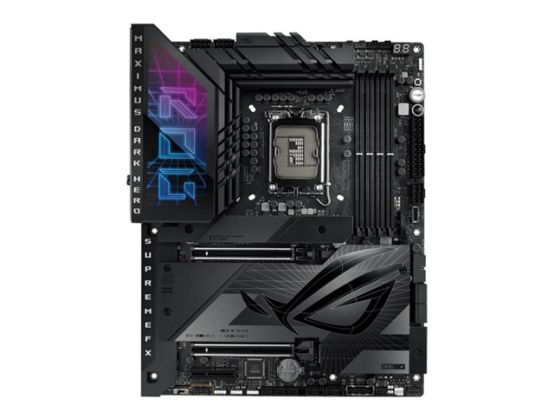
The ROG Maximus Z790 Dark Hero boasts robust cooling, Wi-Fi 7 and ample PCIe 5.0 slot for unmatched performance, and it offers full compatibility with powerful processors. Meanwhile, its stealthy design is accentuated by new Polymo lighting, which illuminates the I/O shroud with a microstructural array of dual-layer RGB and adds a personalized touch of style to your gaming setup.
- ROG overclocking technologies
- Differential sensing
- Teamed power architecture
- Thermal performance
- VRM and aluminum I/O heatsink
- M.2 heatsinks and backplates
- 2.5Gb Ethernet
- PCIE slot Q-release
ROG overclocking technologies
Psyche up and engage the Dark Hero overclocker in you, with onboard intelligence to scan, predict, and adapt CPU performance parameters, and tools to command and track system vitals.
Differential sensing
Conventional motherboards use single-ended sensing tapped from a location that isn't ideal, leading to a large disparity between the actual voltage fed to the CPU and the value reported to software. The ROG Maximus Z790 Dark Hero features a differential-sensing circuit and delicate IC that simplify overclocking and tuning by allowing you to track voltages more accurately.
Teamed power architecture
Today's CPU architectures place incredible demands on motherboard power design by transitioning from deep power-saving modes, going from lower-power mode to full load in an instant. The latest ROG VRM architecture rises to the challenge by utilizing teamed power stages to rapidly swing current, while maintaining exemplary thermal performance.
Thermal performance
Each VRM component serves a specific purpose. PWM controllers and phase-doublers control the circuit, and the power stages do the heavy lifting from an electrical and thermal standpoint. The power stages feature low RDSON to reduce switching and conduction losses, helping to improve overall thermal headroom.
VRM and aluminum I/O heatsink
A VRM heatsink on the MOSFETs and chokes is connected to the aluminum I/O cover via an embedded heatpipe to increase mass and surface area for dissipation.
M.2 heatsinks and backplates
Large aluminum heatsinks provide extensive surface area to cool mounted M.2 drives, and each of the three onboard slots has a dedicated backplate for additional heat dissipation.
2.5Gb Ethernet
Low-latency gaming, speedy file transfers, and high-resolution video streaming are among the many perks of onboard 2.5Gbps Ethernet.
PCIE slot Q-release
A physical button unlocks the first PCIe slot's security latch with one tap, greatly simplifying the process of detaching a PCIe card from the motherboard when it's time to upgrade to a new GPU or other compatible device.