




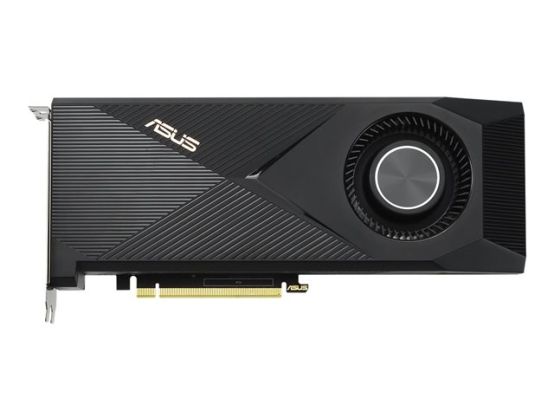
The ASUS Turbo GeForce RTX 3070 is designed from the ground up for chassis with limited space. A newly designed shroud increases air intake for multi-card setups, while maintaining a sleek footprint. Inside, a large blower fan spins on dual ball bearings to whisk copious volumes of air through the heatsink and out of the chassis, making the latest Turbo ideal for deployment in environments where airflow is restricted.
- 2nd Generation RT Cores: experience 2x the throughput of 1st gen RT Cores, plus concurrent RT and shading for a whole new level of ray tracing performance
- 3rd Generation Tensor Cores: get up to 2x the throughput with structural sparsity and advanced AI algorithms such as DLSS
- This GeForce RTX 3070 graphics card with LHR (lite hash rate) delivers 25 MH/s ETH hash rate (est.)
- Redesigned shroud incorporates angles on all edges for optimized airflow
- Dual ball fan bearings can last up to twice as long as sleeve bearing designs
- Auto-Extreme Technology uses automation to enhance reliability
Redesigned shroud
The Turbo features a new shroud designed to look clean while optimizing cooling on several fronts. Every edge has been carefully angled to continuously funnel fresh air to the 80mm blower fan, ensuring thermals remain under control.
Dual ball fan bearings
Different bearing types have unique pros and cons. Ball bearings excel at durability and can last up to twice as long as sleeve bearing designs.
Auto-Extreme Technology
Auto-Extreme Technology is an automated manufacturing process that sets new standards in the industry by allowing all soldering to be completed in a single pass. This reduces thermal strain on components and avoids the use of harsh cleaning chemicals, resulting in less environmental impact, lower manufacturing power consumption, and a more reliable product overall.
Stainless steel bracket
The mounting bracket of the Turbo has been beefed up with 304 stainless steel that's harder and more resistant to corrosion.
Streamlined cable management
The power supply connectors are located on the far side of the card, helping tidy up cable management for a variety of chassis.