




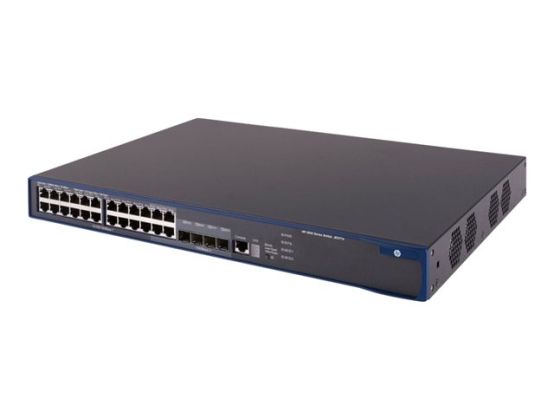
The HPE 5500 EI Switch Series delivers resiliency, security, and multiservice support capabilities at the edge layer of large campus and branch networks. The HPE 5500 EI delivers flexibility, scalability, and low total cost of ownership (TCO) with a robust feature set supporting IRF stacking, Static & RIP Routing, OSPF, BGP, IS-IS, PoE+, ACLs, and IPv6. The 5500 EI Switch Series can be managed with the HPE Intelligent Management Center (IMC) for a single view of your entire network.
- The HPE 5500 EI Switch Series delivers resiliency, security, and multiservice support at the edge layer of your data center and large campus networks.
- The HPE 5500 EI Switch Series is designed with hardware-based wire speed access control lists (ACLs) to provide high levels of security and ease of administration without impacting network performance with a feature-rich TCAM-based ACL implementation.
- The HPE 5500 EI Switch Series supports advanced classifier-based QoS which directs traffic using multiple match criteria based on Layer 2, 3, and 4 information, and applies QoS policies such as setting priority level and rate limit to selected traffic on a port, VLAN, or whole switch.
- The HPE 5500 EI Switch Series supports flexible authentication methods including 802.1X, MAC, and Web Authentication for greater security and policy-driven application authentication.
Resilient, Improved Security and Scalability
Limited Lifetime Warranty and no software licensing required.
Higher Network Performance
Non-blocking architecture delivers up to 192 Gbps of wire speed switching with a non-blocking switching fabric and up to 143 Mpps throughput.
Powerful Quality of Service (QoS) for Traffic Classification
Provides extensive traffic prioritization with congestion actions: strict priority (SP) queuing, weighted round robin (WRR), weighted fair queuing (WFQ), weighted random early discard (WRED), weighted deficit round robin (WDRR), SP+WDRR, and SP+WFQ.
Comprehensive Security Control and Single View of the Network
RMON and sFlow provide advanced monitoring and reporting capabilities for statistics, history, alarms, and events.